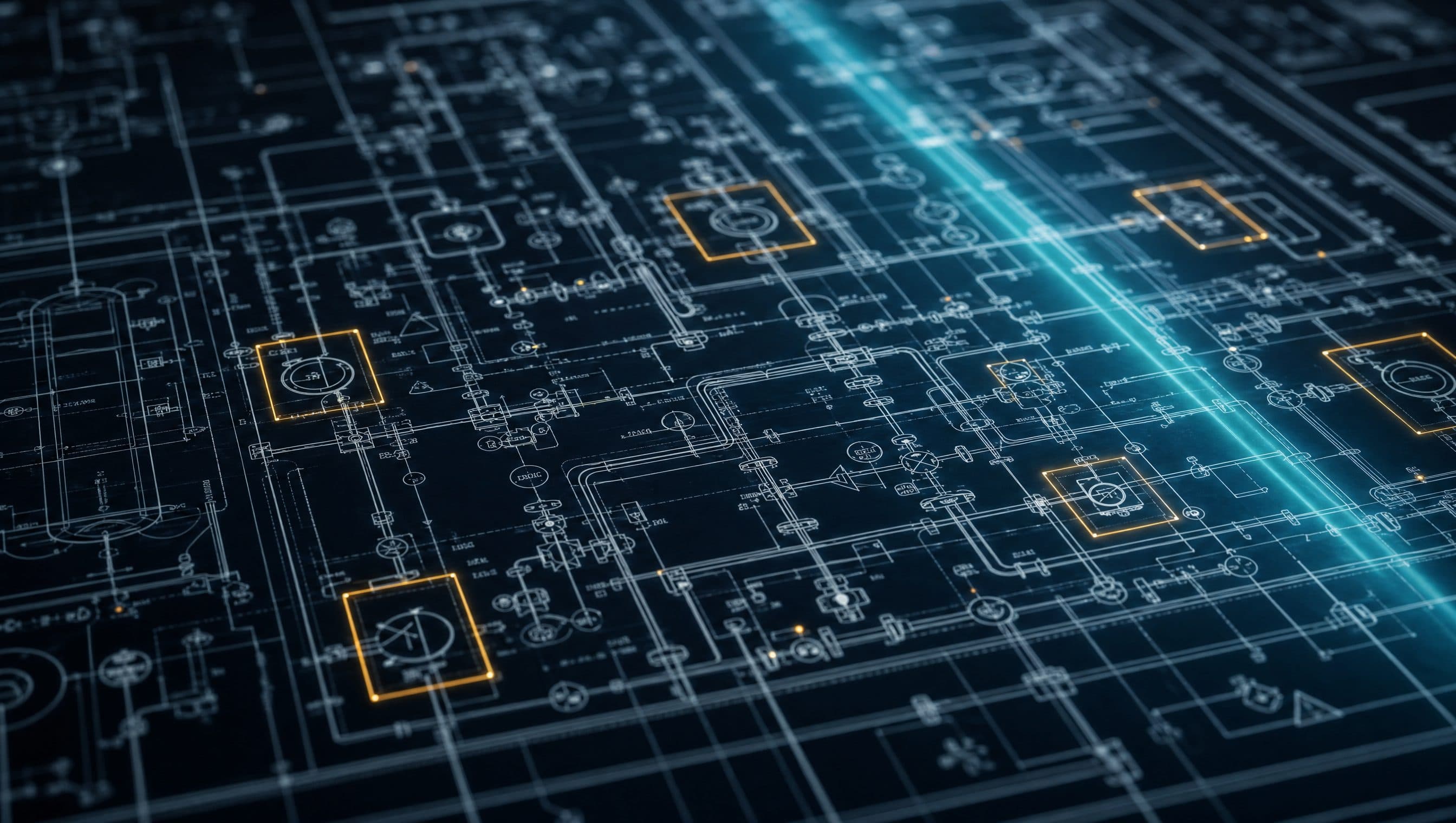
Turn Legacy P&IDs Into Evidence-Linked Engineering Data
I build an extraction model on your drawings and your conventions. You own it, exclusively. Every instrument tag, line number, and alarm setting it extracts links back to the pixels it came from.
No cloud API sees your drawings. Air-gapped delivery available.
Why “Your Model, Yours Only”
Ask any extraction vendor one question: whose drawings was your model trained on? If the answer includes other companies' P&IDs, your drawings are about to join the pile. I take the opposite position: the model is trained from your data, for you, and it belongs to you.
Your model is yours, exclusively
The model is trained from your drawings and delivered to you. It never serves another client, never trains anyone else’s system, and never benefits a competitor.
Your drawings stay in a controlled environment
Processing runs on controlled infrastructure, not a public cloud API. For restricted environments, the entire system ships as an offline package that runs air-gapped, with no external calls of any kind.
Evidence, not assertions
Every extracted value links to the pixels it came from. Accuracy is measured on held-out sheets your team can inspect, not quoted from a benchmark you can’t verify.
What You Receive
Not a spreadsheet dump: a navigable, verifiable dataset your engineers can trust because they can check it.
Instrument Index & Line List
Every instrument balloon, equipment tag, and line number on your drawings, parsed into structured fields, exportable to Excel/CSV for SPI, SAP PM, Maximo, or your migration workbooks.
Alarm & Trip Register
Alarm settings, trip points, and setpoints extracted with their source instruments: the starting dataset for ISA-18.2 alarm rationalization, with evidence for every value.
Interactive Evidence Viewer
A zero-install package your team opens from a folder. Click any extracted value and see the exact pixels it came from, on the exact drawing. No software to procure, no IT project.
Drawing Object Map
Navigate each sheet visually: every detected symbol located and classified, off-page connectors resolved, so reviewers verify against the drawing instead of hunting through it.
How Your Model Gets Built
The process is the product: systematic sample selection, redundant verification, and a review loop that turns your engineers' judgment into a compounding asset.
Calibrate
I select a representative sample of your sheets systematically, using embedding diversity and model uncertainty, not random picks. Your legend and tag conventions become the model’s vocabulary. This is the model build: it starts from a clean base and learns only from your drawings.
Extract & Cross-Check
A detection model proposes every symbol; an independent classifier verifies each one. Where they disagree, the system routes the crop to human review instead of guessing. The system knows when it doesn’t know, so review effort is bounded and accuracy claims are auditable.
Compound
Every correction your engineers make becomes permanent training signal in your model. The verdict ledger records who verified what, and when: a QA audit trail. Batch two is cheaper and more accurate than batch one, and the gains accrue to an asset you own.
Recent engagements include a major North American pipeline operator and a SAGD producer. Client drawing sets are confidential and are never shown, named, or reused.
Where This Pays for Itself
DCS / PLC migrations
Instrument indexes and I/O lists from legacy scanned P&IDs: defensible, evidence-linked, and delivered on a project timeline instead of a manual takeoff timeline.
Alarm rationalization
ISA-18.2 programs need a trustworthy alarm inventory before rationalization can start. Extracting it from drawings by hand is the slowest step. This removes it.
Engineering firms & system integrators
You bid fixed-price. Manual takeoff eats the margin. A calibrated extraction pass changes the economics of every brownfield bid, and the evidence viewer becomes part of your deliverable.
Data handover & digitization
Brownfield asset data programs stall on the drawing backlog. Evidence-linked extraction turns the backlog into structured data your information-management platform can actually ingest.
Records compliance
Regulators ask for records that are traceable, verifiable, and complete. Evidence-linked extraction answers in kind: every value in the register points to the exact pixels on the exact drawing that support it.
MOC & as-built verification
Extract two revisions of the same sheet and compare the data: what changed, what was removed, and whether the change record says so. Undocumented changes surface as data instead of depending on a reviewer catching them.
Also a strong fit for HAZOP and PHA revalidation prep, CMMS and asset-register reconciliation, turnaround scoping, and due diligence on acquired assets.
How Engagements Work
Start small, prove it on your drawings, then scale. No platform subscription, no seat licenses, no lock-in.
Five-Sheet Proof
Free · 48 hours
Send five representative P&IDs. You get back the interactive evidence viewer with extracted tags, lines, and alarms, enough to judge the approach on your own drawings, not a demo corpus.
Calibration Sprint
Fixed fee · 2-3 weeks
The foundational engagement: your model, built. A systematically selected sample of your sheets is annotated and trained against your legend, with an acceptance test on held-out drawings and a written accuracy report.
Production Extraction
Per sheet · Batched
Your calibrated model runs across the full corpus. Deliverables per batch: evidence viewer, instrument index, line list, alarm register, and exports. Optional model care keeps it current as drawing sets evolve.
After Production Extraction
The ladder ends with you in control. Pick the level of independence that fits your team; the model is yours at every tier.
Batch Service
Per batch
New and revised drawings come in per batch; your model runs, and updated deliverables come back: viewer, registers, exports. Your dataset stays current without staffing anything.
Self-Run Extraction
Your model, delivered
You receive your model inside an offline desktop app and run your own extractions on new drawings. No lock-in is meant literally: you can walk away and keep extracting. An optional Model Care retainer sends your team’s corrections back periodically to retrain and sharpen the model.
Own the Factory
Premium
For teams that want full independence: the annotation tooling, the training loop, and hands-on training for your staff. You run calibration in-house; I step back to advisory.
A handed-over model is frozen at delivery. New drawing styles, scanners, and symbols degrade any frozen model over time; that is what Model Care exists for, and it is optional.
Send Five Drawings. Judge for Yourself.
The fastest way to evaluate this is on your own P&IDs, not a demo. Five representative sheets, 48 hours, and you get back an evidence-linked viewer your engineers can pick apart.
Start the Five-Sheet Proof